
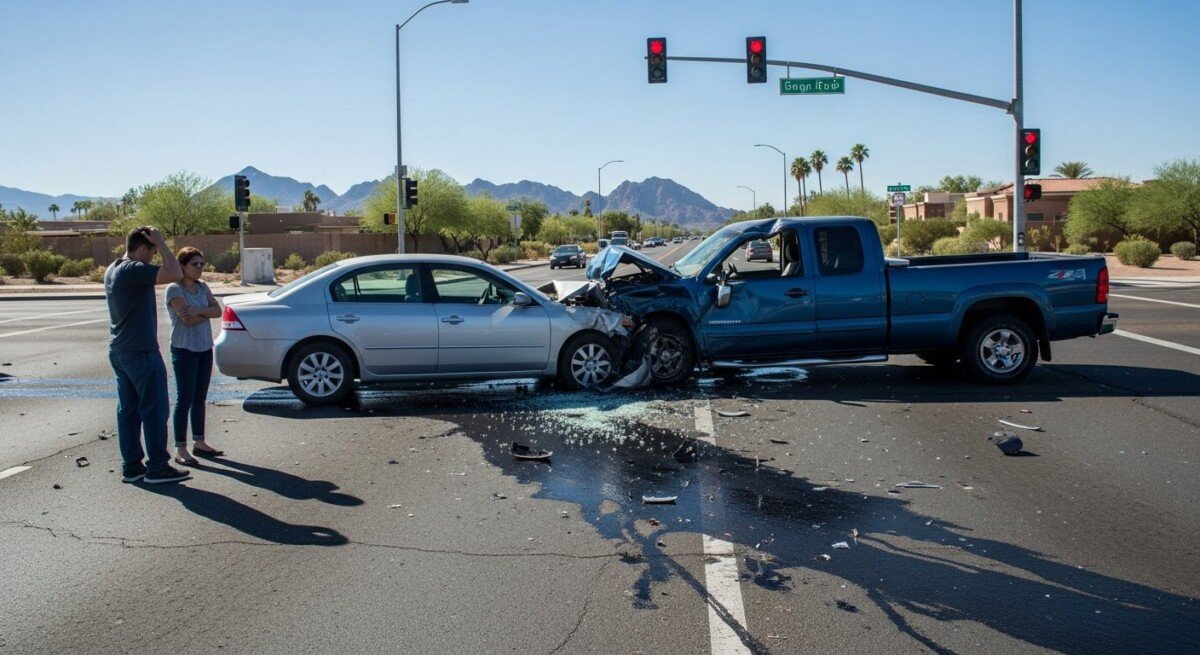
Partial Fault Car Accident Compensation in Phoenix
Yes, Arizona’s comparative negligence law allows compensation even if you were partially at fault. Call 833-227-7919 to discuss protecting your claim.

By Elias Thornton
You’re driving in Phoenix, the light turns yellow, you hesitate, and then a collision occurs. In the aftermath, a nagging question emerges: “Can I still get compensation if I was partially at fault for the car accident in Phoenix?” The immediate fear is that any admission of fault will bar you from recovery entirely. This is a common misconception. Arizona law provides a clear, though nuanced, path to compensation even when you share some blame. Understanding the state’s comparative negligence rule is not just legal trivia, it is the key to protecting your rights and securing the financial recovery you need for medical bills, lost wages, and vehicle repairs.
Arizona’s Pure Comparative Negligence Rule Explained
Unlike some states that bar recovery if you are 50% or 51% at fault, Arizona follows a legal doctrine known as “pure comparative negligence.” This principle is foundational to answering the core question of compensation after a partially-at-fault accident. Under Arizona Revised Statutes section 12-2505, the financial responsibility for damages is divided among all parties based on their percentage of fault. This means your own degree of fault does not eliminate your claim, it merely reduces the total amount you can recover. The court or insurance adjuster will assign a percentage of fault to each driver involved. Your final compensation award is then calculated by subtracting your percentage of fault from the total damages. For example, if you are found to be 30% responsible for an accident that caused $100,000 in total damages, you would be eligible to recover $70,000 (which is $100,000 minus 30%, or $30,000). This system is designed to apportion financial responsibility fairly, even in complex multi-vehicle collisions where fault is shared.
How Fault is Determined in Phoenix Car Accidents
Establishing fault percentages is not a simple binary decision. Insurance adjusters and, if necessary, courts will conduct a detailed investigation, piecing together evidence to build a picture of the event. They look at a constellation of factors to assign responsibility. This process is critical because the assigned percentage directly dictates your potential recovery. Key evidence includes the official police report, which contains the responding officer’s observations and any citations issued. Witness statements provide independent accounts of the sequence of events. Photographs and video from the scene, traffic cameras, or dashcams can be invaluable. Physical evidence, like skid marks, vehicle damage locations, and road conditions, is also analyzed. Furthermore, state traffic laws (Arizona Revised Statutes Title 28) are used as a benchmark for driver duty. Violations such as speeding, failure to yield, improper lane changes, or distracted driving are strong indicators of fault. It is important to remember that fault can be shared in many ways: one driver may have been speeding while the other ran a stop sign. The investigation aims to quantify the contribution of each action to the cause of the crash.
The Critical Steps to Protect Your Claim
Your actions in the immediate aftermath of a Phoenix accident where you may share fault are paramount. What you say and do can significantly impact the fault determination process and the strength of your subsequent claim for compensation. A misstep can inadvertently increase your assigned percentage of blame. Following a structured approach is essential to preserve your rights under Arizona’s comparative negligence system.
To safeguard your position, consider these steps:
- Prioritize Safety and Documentation: Move to a safe location if possible, call 911 for medical and police response, and exchange basic information with the other driver (name, insurance, vehicle details). Use your phone to take comprehensive photos of the vehicles, license plates, injuries, road conditions, traffic signs, and skid marks.
- Choose Your Words Carefully: When speaking with the other driver, witnesses, or the police, stick to the factual observations. Avoid speculating, admitting fault, or making definitive statements like “I’m sorry” or “I didn’t see you.” Simply state what happened factually (e.g., “I was proceeding through the intersection when the collision occurred”) and let the investigation determine cause.
- Seek Immediate Medical Attention: Some injuries, like whiplash or internal trauma, have delayed symptoms. A medical record created shortly after the accident directly links your injuries to the crash, which is vital for claiming damages. Delaying treatment can be used by insurers to argue your injuries were not serious or were caused by something else.
- Notify Your Insurer Promptly: Report the accident to your own insurance company as required by your policy. Provide them with the basic facts and the police report number, but refrain from giving a detailed recorded statement, especially to the other driver’s insurer, without legal counsel.
- Consult a Phoenix Personal Injury Attorney Early: This is perhaps the most crucial step in a partial-fault scenario. An experienced attorney can guide you through interactions with insurance companies, help gather and preserve evidence, and advocate for the most favorable fault allocation possible.
Navigating Insurance Negotiations with Shared Fault
Dealing with insurance adjusters becomes exponentially more complex when comparative negligence is a factor. The other driver’s insurer has a vested interest in maximizing your percentage of fault to minimize their payout. They may use early, low-ball settlement offers or aggressive questioning to get you to admit to actions that increase your liability. It is critical to understand that Arizona is a “fault” state for car accidents, meaning you typically file a claim against the at-fault driver’s insurance policy. However, you may also utilize your own coverage, such as MedPay or collision coverage, depending on your policy. The negotiation process will involve a back-and-forth on both the total value of your damages (medical expenses, lost income, pain and suffering) and the proposed split of fault. Having an attorney negotiate on your behalf is often the difference between a settlement that reflects a fair apportionment and one that unfairly penalizes you. Your lawyer will present evidence to counter the insurer’s arguments and fight to keep your assigned fault percentage as low as the evidence allows. For a deeper understanding of what constitutes compensable injury, including non-physical harm, our article on compensation for anxiety after a car crash details how emotional distress is evaluated in Arizona claims.
Calculating Your Damages Under Comparative Negligence
To understand what compensation you might receive, you must first calculate your total damages, then apply the fault reduction. Damages in a Phoenix car accident case generally fall into two categories: economic and non-economic. Economic damages are tangible, out-of-pocket losses. These include all medical bills (from emergency room visits to ongoing physical therapy), lost wages and loss of future earning capacity, property damage (vehicle repair or replacement), and other documented expenses like rental car costs. Non-economic damages are more subjective but equally important. They compensate for pain and suffering, emotional distress, loss of enjoyment of life, and loss of consortium. Quantifying these requires considering the severity and permanency of your injuries. Once a total damage figure is established, your percentage of fault (e.g., 20%) is applied. If your total damages are $150,000 and you are 20% at fault, your recoverable compensation is $120,000. It is vital to work with an attorney to ensure every category of damage is thoroughly documented and valued, as this forms the base number from which your final recovery is derived.
When Your Case Might Go to Court
While most personal injury claims settle out of court, disputes over the degree of fault or the value of damages can lead to litigation. If you and the insurance company cannot agree on a fair settlement that accounts for shared responsibility, filing a lawsuit may be necessary. In court, a judge or jury will hear the evidence and make a formal determination on fault percentages and award damages accordingly. The same pure comparative negligence rule applies. Litigation is a more time-consuming and formal process, but it can be the only path to just compensation when an insurer refuses to acknowledge a fair share of liability. Having legal representation is essential at this stage, as procedural rules are strict and the stakes are high. An attorney will handle all aspects of the lawsuit, from filing the complaint and engaging in discovery (the formal exchange of evidence) to presenting your case at trial.
Frequently Asked Questions
What if I was 90% at fault for the Phoenix accident? Under Arizona’s pure comparative negligence rule, you can still recover compensation even if you are 90% at fault. If your total damages are $100,000, you would be eligible to recover 10%, or $10,000, from the other party who was 10% at fault.
Will my own insurance rates go up if I’m partially at fault? Likely, yes. Arizona insurers can raise your premiums based on your involvement in an accident, especially if you are assigned a significant portion of the fault. The impact depends on your specific policy and driving history.
How long do I have to file a claim after a Phoenix accident? Arizona’s statute of limitations for personal injury claims is generally two years from the date of the accident (A.R.S. section 12-542). For property damage only, it is also two years. Missing this deadline will almost certainly bar your claim forever.
What if the other driver is uninsured or underinsured? Your own uninsured/underinsured motorist (UM/UIM) coverage can be crucial in this scenario. This coverage is designed to protect you when the at-fault driver lacks sufficient insurance. Arizona requires insurers to offer UM/UIM coverage, and it is highly recommended. Navigating a UM claim when fault is shared involves specific legal strategies, which is another reason to consult an attorney. For guidance on selecting the right legal advocate for such complex matters, our attorney selection guide offers a framework for evaluating experience and fit.
Can I be denied compensation for not wearing a seatbelt? Arizona has a “seatbelt defense” law (A.R.S. section 28-909). If you were not wearing a seatbelt, the other party can argue that your injuries were made more severe by this failure. This could lead to a reduction in your non-economic damages (like pain and suffering) based on your percentage of fault for enhancing your own injuries, but it does not completely bar recovery for the underlying accident itself.
Understanding the interplay between partial fault and compensation is vital for any driver in Phoenix. The system is designed to ensure that those who suffer harm receive a fair recovery proportional to the other party’s responsibility. However, securing that fair recovery requires knowledge, careful action, and often, skilled legal advocacy. By taking the right steps after an accident and seeking professional guidance, you can effectively navigate the complexities of Arizona’s comparative negligence law and work towards the financial recovery you deserve. For insights into how insurance companies might act in bad faith during such claims, you can read about bad faith insurance tactics. Furthermore, understanding broader legal principles is helpful, as discussed in our overview of administrative law and its processes.