
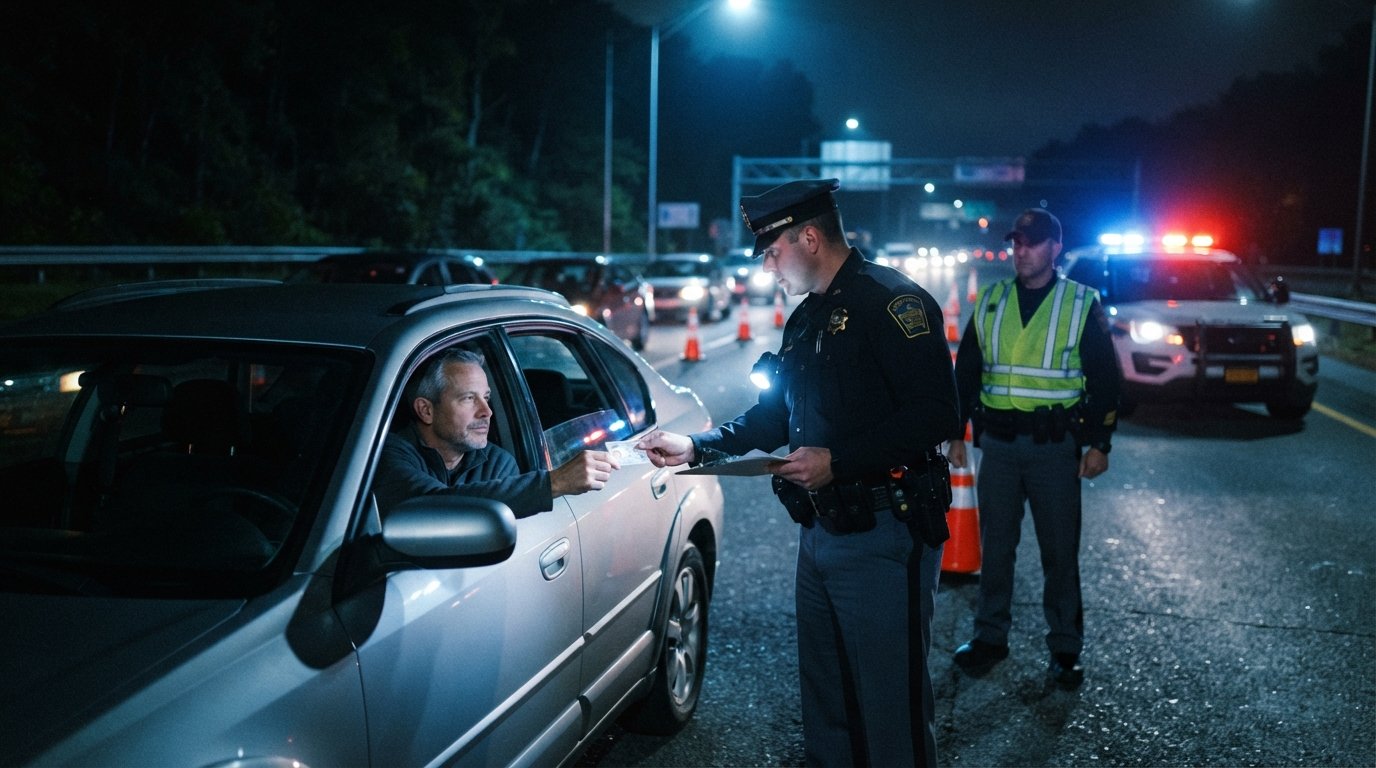
Pennsylvania DUI Checkpoint Rights: What to Expect
Learn your rights at Pennsylvania DUI checkpoints, what to expect during the stop, and how to protect yourself legally.

By Lenora West
Few moments on the road feel more unsettling than seeing flashing lights ahead and realizing you are approaching a DUI checkpoint. In Pennsylvania, these sobriety checkpoints are legal, but they operate under strict rules designed to balance public safety with your constitutional protections. Understanding your rights and what to expect can transform a nerve-wracking experience into a manageable one.
This guide walks you through the legal framework of Pennsylvania DUI checkpoints, your rights during the stop, the proper way to interact with officers, and the consequences of refusing a breath test. You will also learn how to document the encounter and where to turn for legal help if you believe your rights were violated.
The Legal Foundation of DUI Checkpoints in Pennsylvania
DUI checkpoints in Pennsylvania are not random police actions. They are carefully planned operations that must comply with both state law and the United States Constitution. The Fourth Amendment protects citizens from unreasonable searches and seizures, and the Pennsylvania Supreme Court has established specific guidelines to ensure sobriety checkpoints do not cross that line.
In the landmark case Commonwealth v. Tarbert, the court ruled that checkpoints are permissible only when they follow a systematic and non-discriminatory method of stopping vehicles. This means officers cannot pull over cars based on personal discretion or profiling. Instead, they must stop every vehicle, or every nth vehicle, according to a pre-determined formula. The checkpoint must also be publicized in advance, and its primary purpose must be to detect and deter drunk driving, not to conduct general criminal investigations.
These requirements create a legal framework that protects you. If the police deviate from these rules, any evidence they gather may be inadmissible in court. For a deeper look at how serious DUI offenses are handled in other jurisdictions, you can review our analysis of Alabama felony DUI law, which highlights how state approaches vary.
Your Rights at a Checkpoint: What You Can and Cannot Do
Knowing your rights is different from knowing how to exercise them in the moment. At a Pennsylvania DUI checkpoint, you have specific legal protections, but you also have obligations. Here is a breakdown of what you should remember.
The Right to Remain Silent and Avoid Self-Incrimination
You are not required to answer questions beyond identifying yourself and providing your license, registration, and proof of insurance. When an officer asks where you have been or whether you have been drinking, you can politely decline to answer. Simply state, "I prefer not to answer questions without my attorney present." This is not an admission of guilt. It is a protected exercise of your Fifth Amendment rights.
The Right to Refuse Field Sobriety Tests
Field sobriety tests, such as walking a straight line or standing on one leg, are voluntary in Pennsylvania. You can refuse them without facing automatic legal penalties. However, refusing these tests may still be used as evidence of intoxication in court, and officers may rely on their observations of your appearance and behavior to establish probable cause for a breath test.
The Right to Legal Counsel
Once you are detained, meaning a reasonable person would not feel free to leave, you have the right to request an attorney. This is particularly important if you are asked to take a chemical test. While the right to counsel applies during custodial interrogation, it is limited when it comes to breath tests. Pennsylvania courts have held that you do not have a right to speak with an attorney before deciding whether to submit to a blood or breath test, but you can request one after the test is complete.
What Happens During a Typical Pennsylvania DUI Checkpoint
Understanding the sequence of events can reduce anxiety and help you respond appropriately. The entire process is designed to be brief, usually lasting only a few minutes if you have not been drinking.
- Approach and Stop: You will see signs and flashing lights well in advance. Slow down, put on your seatbelt, and turn on your interior lights if it is dark. Stop when directed by an officer in a reflective vest.
- Initial Contact: The officer will identify the checkpoint and ask for your license, registration, and proof of insurance. They may also ask if you have consumed any alcohol.
- Observation: The officer will look and listen for signs of impairment, such as slurred speech, bloodshot eyes, or the smell of alcohol. This brief observation is legal without a warrant because it occurs in plain view.
- Questioning: You may be asked where you are coming from and where you are going. These questions are designed to elicit responses that reveal impairment. You can provide brief, non-incriminating answers or decline to answer.
- Field Sobriety Tests: If the officer suspects impairment, you will be asked to step out of the vehicle for field sobriety tests. As noted, these are voluntary.
- Preliminary Breath Test (PBT): You may be asked to blow into a portable breathalyzer. In Pennsylvania, submitting to a PBT is also voluntary. However, if you refuse, the officer may arrest you based on other observations and take you to the station for a formal chemical test.
- Release or Detention: If no suspicion arises, you will be released quickly. If the officer develops probable cause, you will be arrested and transported for processing.
Implied Consent and the Consequences of Refusing a Chemical Test
Pennsylvania's implied consent law, found in Title 75 of the Vehicle Code, creates a crucial distinction. By driving on state roads, you automatically consent to chemical testing if an officer has reasonable grounds to believe you are under the influence.
If you refuse a blood or breath test after a lawful arrest, you face separate penalties under the civil code. The Pennsylvania Department of Transportation (PennDOT) will suspend your driver's license for 12 months for a first refusal, 18 months for a second refusal, and 18 months for a third or subsequent refusal. These suspensions are civil, not criminal, meaning they occur even if you are found not guilty of the DUI charge.
Refusal also carries criminal consequences. Under Pennsylvania law, a DUI conviction with a refusal can result in enhanced penalties, including higher fines, longer jail time, and mandatory ignition interlock devices. Moreover, your refusal can be used as evidence against you at trial. Prosecutors will argue that a sober person would have complied with the test to prove their innocence.
Weighing the risks of refusal against the risks of a DUI conviction is complex. An experienced attorney can help you understand how a refusal might impact your specific case. If you need legal guidance after a checkpoint encounter, you can request a free case evaluation through a service like FreeLegalCaseReview, which connects individuals with qualified attorneys.
Can You Legally Avoid a DUI Checkpoint?
Drivers sometimes wonder if they can turn around or take an alternate route to avoid a checkpoint. The short answer is yes, but only if you do so safely and legally.
You are allowed to turn onto a side street or make a U-turn before reaching the checkpoint, provided you do not violate traffic laws and you do so without creating a hazard. However, if an officer observes you making an illegal turn or driving erratically to avoid the checkpoint, that action can provide independent probable cause for a traffic stop. Police may also station officers near the checkpoint to watch for these maneuvers. If you are stopped for an illegal turn, the officer can then investigate whether you are under the influence.
It is also important to note that you cannot stop your car before the checkpoint and wait. Doing so may be suspicious, and officers may approach your vehicle. The safest approach is to drive through the checkpoint normally, remain calm, and assert your rights politely.
How to Document a Checkpoint Stop for Future Legal Action
If you believe your rights were violated at a Pennsylvania DUI checkpoint, documentation is your most powerful tool. Memory fades quickly, and precise records can make the difference in a motion to suppress evidence.
Immediately after the stop, write down everything you remember. Include the date, time, and exact location. Note the weather conditions and how many officers were present. Describe the signage and whether the checkpoint appeared to be stopping every vehicle or following a pattern. Record the names and badge numbers of the officers you interacted with, and note anything they said that seemed inappropriate or unconstitutional.
If you have a passenger, ask them to document their observations independently. If you used a dash camera or your phone to record video (where legal), preserve the footage without editing. Pennsylvania is a two-party consent state for audio recordings, but video without audio is generally permissible in public spaces. However, you should never obstruct an officer or interfere with the checkpoint to record. That could lead to separate charges.
This documentation is not just for your own records. It can be shared with your defense attorney, who can use it to challenge the legality of the stop. For example, if the checkpoint did not have proper advance publicity, or if officers were stopping vehicles without following the neutral formula, your attorney may file a motion to suppress all evidence obtained from the stop, which could lead to a dismissal of charges.
What to Do After a DUI Checkpoint Arrest in Pennsylvania
An arrest at a checkpoint does not automatically mean a conviction. The legal process in Pennsylvania is nuanced, and many defenses exist. The first step is to remain silent and request an attorney. Do not answer questions about your drinking, and do not attempt to explain or justify your actions. Politely state that you will cooperate after consulting with counsel.
You will be taken to a police station where you will be asked to submit to a chemical test. After you are processed, you will typically be released on bail or on your own recognizance. You will receive a date for a preliminary hearing, and PennDOT may send a notice about a license suspension if you refused testing.
Your attorney will review the checkpoint's compliance with state guidelines, the officer's observations, and the accuracy of any testing equipment. Common defenses include challenging the checkpoint's constitutionality, questioning the officer's training, and disputing the reliability of blood or breath test results. In some cases, a skilled attorney can negotiate a plea to a lesser charge, such as reckless driving, which carries fewer long-term consequences than a DUI.
The aftermath of a checkpoint arrest can be financially and emotionally draining. You may face job loss, increased insurance rates, and the stigma of a criminal record. Acting quickly to secure legal representation is critical. Many attorneys offer free initial consultations, and some services provide free case evaluations with no obligation to hire.
Remember, encountering a DUI checkpoint is stressful, but it is a temporary situation. By knowing your rights, staying calm, and seeking qualified legal help when needed, you can protect your future and ensure that the system works as it should.